

Introduction
Most business owners think about shipping in simple terms: a carrier picks up a pallet, drives it across the country, and delivers it. The reality is more layered than that. Behind every LTL shipment is a network of freight hubs that sort, consolidate, and redirect cargo at multiple points along the route. These distribution centers are the engine of the Canadian freight network, and understanding how they work can fundamentally change how you plan your shipments.
Whether you ship from Montreal to Vancouver or from Toronto to Halifax, your freight almost certainly passes through at least one hub facility. For small and medium-sized businesses, knowing how hub-based routing affects transit time and cost is not just interesting. It is a practical advantage that leads to smarter carrier choices, better delivery expectations, and fewer surprises on the receiving dock.

What Are Freight Hubs and Why Do They Exist?
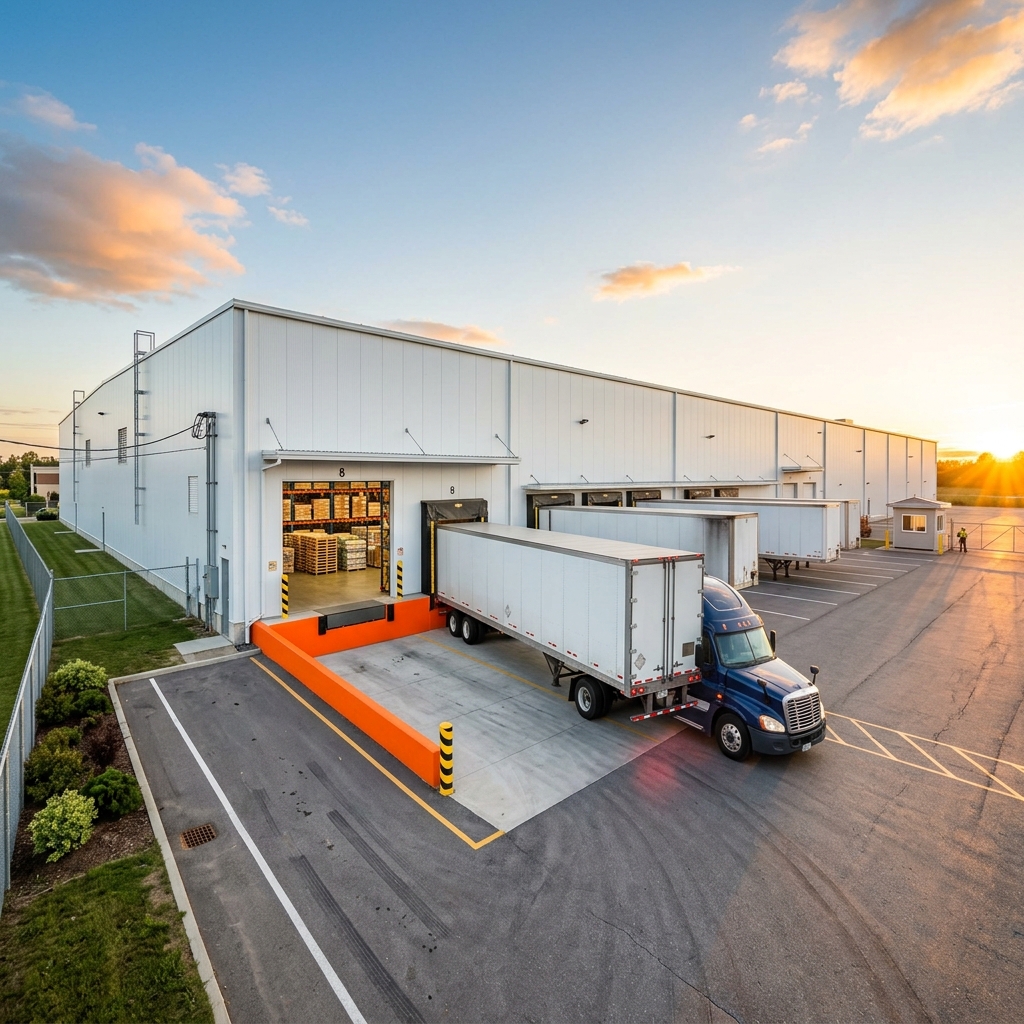
A freight hub is a centralized distribution facility where LTL shipments are received from multiple origin points, sorted by destination, and reloaded onto outbound trucks. Unlike a traditional warehouse, a hub is not designed for long-term storage. Its entire purpose is movement. Cargo arrives, is processed, and departs again as quickly as possible, often within hours.
The reason hubs exist comes down to economics and geography. Canada is a vast country, and carriers cannot afford to run half-empty trucks between every city pair on the map. By routing shipments through centralized freight distribution hubs, carriers consolidate freight from dozens of shippers onto fewer, fuller trucks. This lowers the cost per unit of freight and allows carriers to offer LTL pricing that would be impossible to sustain with direct-route trucking alone.
The Core Functions of a Freight Hub
A modern freight hub typically performs several critical functions simultaneously. Understanding these explains both the speed advantages and the occasional delays that come with hub-based routing.
- Freight consolidation: Shipments from multiple customers headed to the same region are combined onto a single outbound trailer, filling truck capacity and reducing per-shipment costs.
- Sortation and staging: Incoming pallets are scanned, sorted by destination lane, and staged for outbound loading in sequence, minimizing the time freight sits idle on the dock floor.
- Cross-docking: Freight moves directly from an inbound truck to an outbound truck without entering general storage, keeping dwell time at the hub to a minimum.
- Linehaul relay: Long-haul routes are divided into legs, with hubs acting as relay points where one driver or trailer hands off freight to another for the next leg of the journey.
- Exception handling: Damaged freight, missing documentation, or misrouted pallets are identified and corrected at the hub before they travel farther in the wrong direction.
Freight Hubs vs. Warehouses: A Critical Distinction
People often confuse freight hubs with warehouses, but the two serve entirely different purposes. A warehouse is a storage facility. Goods enter, stay for days or weeks, and leave when needed. A hub is a flow-through facility. Dwell time is measured in hours, not days, and any freight sitting at a hub longer than planned is a sign of a problem, not normal operations.
This distinction matters when you are tracking a shipment. If a carrier's tracking system shows your pallet has been at a hub location for more than 24 hours, it is worth contacting dispatch to understand why. In a well-run hub operation, freight should be in and out within a standard processing window, typically four to eight hours depending on volume.
How Hub Networks Scale with Shipment Volume
One of the lesser-known advantages of hub-based consolidation services is that they allow carriers to add service lanes without proportionally increasing their fleet. When a new business lane opens between two cities, a carrier does not need to run a dedicated truck. They simply route that freight through an existing hub that already has outbound capacity in that direction. For small businesses, this means access to a far wider range of destinations than any single carrier could serve with point-to-point routes alone.

Cross-Docking: The Speed Mechanism Inside Every Hub
Of all the operations that happen inside a freight hub, cross-docking is the one that has the most direct impact on delivery speed. It is also one of the most misunderstood concepts in freight logistics. Getting clear on how it works helps set realistic expectations for LTL transit times.
What Cross-Docking Actually Looks Like
In a cross-dock freight hub operation in Canada, inbound trailers back into one side of the facility while outbound trailers wait on the other. When an inbound truck arrives, dock workers unload each pallet, scan it, and carry or push it across the dock floor to the correct outbound lane. The pallet is then loaded directly onto the waiting outbound trailer. At no point does the freight enter a storage rack or holding area.
The efficiency gain is significant. Traditional freight handling might involve multiple stages of storage and retrieval before a pallet reaches its next truck. Cross-docking collapses all of that into a single, continuous movement across the facility floor. According to the CITT logistics glossary, cross-docking is one of the defining techniques that distinguishes LTL terminal operations from general warehousing, and its proper execution is a direct predictor of carrier reliability.
When Cross-Docking Speeds Things Up and When It Slows Them Down
Cross-docking accelerates delivery when freight volumes are predictable and outbound trailers are ready to depart on schedule. If your shipment arrives at a hub just before an outbound truck for your destination is set to leave, it can be cross-docked and on its way within the hour. That is the best-case scenario, and it happens routinely in well-managed hub networks during normal operating periods.
The risk appears when volumes spike or schedules misalign. If your pallet arrives at the hub an hour after the last outbound truck for its lane has departed, it will wait for the next scheduled departure. During peak shipping periods, that wait can extend to the next business day. This is why LTL shipment routing through freight hubs benefits from carrier selection based on schedule frequency, not just price.
The Role of Technology in Modern Cross-Docking
Leading carriers now use barcode scanning, RFID tagging, and warehouse management systems to automate sortation decisions at the dock. When a pallet is scanned on arrival, the system immediately assigns it to an outbound lane, generates a loading instruction for dock workers, and updates the shipment's tracking record. This reduces handling errors and speeds up the physical movement of freight across the facility. Businesses that rely on real-time shipment tracking benefit directly from these integrations, since every hub scan generates a new data point that updates the estimated delivery window.
Major Freight Hubs in Canada and the Quebec-Ontario Corridor
Canada's freight hub network is concentrated along the St. Lawrence corridor and the Trans-Canada highway system, with the highest density of hub facilities in the provinces of Quebec and Ontario. Understanding where these hubs are located helps businesses predict how many relay points their freight will pass through on any given lane.
Freight Hubs in Toronto and Southern Ontario
The Greater Toronto Area is home to some of the busiest freight hub facilities in the country. Carriers operating in the freight hubs in the Toronto area benefit from the region's position at the intersection of east-west transcontinental routes and north-south cross-border lanes into the United States. The area around Mississauga and Brampton, in particular, is dense with carrier terminal facilities that serve as relay hubs for both inbound and outbound LTL freight. For businesses shipping from southern Ontario, this concentration of infrastructure generally means shorter dwell times and more frequent outbound departures compared to more remote origin points.
Ontario more broadly is a critical node in the LTL freight hubs landscape, given that the province accounts for a significant share of Canada's total freight movement. The Statistics Canada freight data consistently shows Ontario as the origin or destination for a disproportionate share of national trucking activity, which is why carriers prioritize hub capacity there.
Freight Hubs Montreal and the Quebec Network
Montreal functions as the primary eastern gateway hub in Canada's LTL network. Freight hubs in Montreal handle traffic flowing from the Maritimes westward, from Quebec City and the regions south toward the border, and from Ontario moving east. The Montreal hub market is also notable for bilingual operational requirements, with carriers needing to meet both federal and provincial transportation standards under Quebec's regulatory framework.
For businesses operating in the freight hubs in the Quebec-Ontario corridor, the Montreal-Toronto lane is one of the most heavily served in the country. This means frequent departures, competitive rates, and shorter transit windows than almost any other interprovincial lane. However, it also means higher volume at hub facilities during peak periods, which can occasionally introduce processing delays during holidays or high-demand shipping weeks.
Western and Atlantic Hub Connections
Beyond the Quebec-Ontario core, Canada's freight hub network extends to major facilities in Calgary and Edmonton serving Western Canada, and regional hubs in Halifax and Moncton serving the Atlantic provinces. Shipments traveling to these regions from Ontario or Quebec will typically pass through two or more hub relay points, adding one to two transit days depending on the carrier's linehaul schedule. This helps businesses set accurate delivery expectations with their customers rather than quoting transit times based on direct-drive assumptions that do not reflect how LTL networks actually operate. The Transportation Canada 2023 annual report outlines the scale of interprovincial freight movement and highlights the importance of hub infrastructure in supporting national supply chains.
How Freight Hub Routing Affects Delivery Timelines
Transit time in LTL shipping is not simply a function of distance. It is a function of the number of hub touches, the frequency of outbound departures on each lane, and how well the carrier's schedule aligns with when your freight arrives. Understanding these variables is what separates businesses that set accurate delivery expectations from those that routinely disappoint their customers.
Hub Touch Count and Transit Days
Each time a shipment is unloaded, sorted, and reloaded at a hub facility, it adds handling time and the possibility of a schedule miss. A direct lane between two cities with a single hub touch might deliver in two business days. The same physical distance, routed through a carrier with three hub touches, might take four days. This is why a freight hub transit speed comparison is a meaningful metric when choosing between carriers. Two quotes at similar prices might represent very different service levels depending on how each carrier routes freight through its hub network.
For businesses that need to compare these variables before booking, platforms that surface route and transit data alongside rate quotes provide a genuine advantage. Truxweb allows shippers to compare transit speeds and carrier ratings side by side, giving businesses the information they need to make a decision that balances cost with delivery performance rather than choosing on price alone.
How Hub Frequency Impacts Departure Windows
Carriers do not run outbound trucks from every hub on demand. They operate on fixed schedules, with outbound departures from each lane happening once or twice per day depending on volume. If your freight arrives at a hub just after the last outbound departure for your destination lane, it waits for the next window. For lanes with only one daily departure, that can mean a full 24-hour delay added to your transit time with no fault on anyone's part. This is a structural feature of hub-based shipping, not a failure, and it is one of the reasons that a freight hub vs. full truckload shipping comparison often shows FTL performing better on time-sensitive lanes where departure windows cannot be guaranteed.
Optimizing Pickup Timing to Avoid Hub Delays
One practical way to reduce the risk of missing an outbound window is to align your pickup schedule with the carrier's inbound cutoff time at the originating terminal. Most carriers publish their linehaul departure schedules internally, and a good freight platform or broker can tell you what time a shipment needs to be at the origin terminal to make the day's last outbound truck. Booking pickups earlier in the day rather than late afternoon is a simple discipline that can reliably shave a full transit day off many LTL lanes.
Freight Hubs and the Cost Equation for Small Businesses
For small and medium-sized businesses, the freight hub network is both an opportunity and a complexity to navigate. On one hand, hub-based consolidation is what makes LTL pricing accessible in the first place. On the other hand, choosing a carrier without understanding their hub structure can lead to longer transit times and higher costs than necessary.
Why Hub Consolidation Reduces Per-Shipment Cost
When multiple small shipments are consolidated at a hub onto a single outbound trailer, every shipper on that load shares the linehaul cost proportionally. This is the fundamental economics of LTL shipping and the reason why the best freight hub solutions for small businesses in Canada are built around hub networks rather than point-to-point trucking. A small business shipping a single pallet from Montreal to Calgary could never afford to charter a truck for that lane. But by contributing that pallet to a hub-consolidated load, they pay only for the space their freight occupies.
Accessing Hub Networks Through Digital Freight Marketplaces
Historically, accessing multiple carrier hub networks required relationships with freight brokers or direct accounts with each carrier, a setup that favored large shippers with volume leverage. Digital freight platforms have changed that dynamic significantly. By connecting small businesses to a curated network of carriers through a single interface, these platforms give SMBs access to the same hub-connected carrier options that larger shippers have always had. The freight hub marketplace comparison in Canada has become a meaningful exercise for businesses that previously had no easy way to evaluate which carriers offered the best hub network coverage for their specific origin-destination pairs.
Balancing Cost and Hub Network Quality
Not all hub networks are created equal. A lower-priced carrier may operate with fewer hub locations, meaning more relay points and longer transit times. A premium carrier may have more direct lane coverage with fewer touches. For shipments where delivery speed is the priority, paying a modest premium for a carrier with a more direct hub routing is often the right call. For regional LTL carriers, hub network quality within a specific corridor often matters more than national reach, and a regional carrier with a tight hub network in Quebec or Ontario may outperform a national carrier on local lanes both in speed and reliability.
Conclusion
Freight hubs are not just logistics infrastructure. They are decision points that determine how fast your shipment moves, how much it costs, and how reliably it arrives. Understanding consolidation, cross-docking, and the geography of Canada's major hub locations gives businesses a genuine edge in freight planning. The Quebec-Ontario corridor, hubs in Toronto and Montreal, and the wider national network all follow predictable patterns that, once understood, make it far easier to choose the right carrier, set accurate delivery expectations, and avoid the most common causes of LTL delay. Businesses that treat hub routing as part of their carrier evaluation process will consistently outperform those that shop on rate alone.
Ready to compare carriers across Canada's freight hub network? Start a quote on Truxweb and see transit times, rates, and carrier ratings side by side in minutes.
Frequently Asked Questions (FAQs)
What is a freight hub?
A freight hub is a centralized distribution facility where LTL shipments from multiple origins are received, sorted by destination, and reloaded onto outbound trucks. Unlike a warehouse, a hub is designed for rapid movement, not storage.
How do LTL shipments move through freight hubs?
LTL shipments arrive at a hub on inbound trailers, are unloaded and sorted by destination lane, then loaded onto outbound trailers heading in the right direction. This process often repeats at multiple hub relay points along the full route.
What is cross-docking at a freight hub?
Cross-docking is when freight moves directly from an inbound truck to an outbound truck at a hub facility without entering storage. It is the fastest form of hub processing and the primary technique carriers use to minimize dwell time between linehaul legs.
How do freight hubs improve delivery times?
Hubs improve delivery times by consolidating freight efficiently and enabling carriers to run full trucks on high-frequency schedules. When a shipment reaches a hub and an outbound truck for its destination is ready to depart, transit time is significantly reduced compared to waiting for a dedicated direct route.
What freight hubs serve Quebec and Ontario?
The Quebec-Ontario corridor is served by major hub facilities in Montreal and the Greater Toronto Area, including terminals concentrated around Mississauga and Brampton. These hubs handle some of the highest LTL volumes in Canada and support frequent daily departures on that lane.
What are the major freight hubs in Canada?
Canada's major freight hubs are concentrated in Montreal, Toronto, Calgary, Edmonton, Halifax, and Moncton. These facilities serve as the primary relay and consolidation points for interprovincial LTL traffic across the country.
Is it cheaper to ship LTL through a freight hub?
Yes. Hub-based consolidation is what makes LTL pricing affordable for small shipments. By sharing outbound trailer space with other shippers, each business pays only for its proportional share of the linehaul cost rather than chartering a dedicated truck.
How does freight hub consolidation reduce shipping costs?
Consolidation at a hub fills trailers to capacity using freight from multiple shippers headed to the same region. This lowers the cost per unit of freight dramatically compared to running a partially loaded direct truck, and those savings are passed to shippers through LTL pricing.
What is the difference between a freight hub and a warehouse?
A freight hub is a flow-through facility designed to move freight quickly, with dwell times measured in hours. A warehouse is a storage facility where goods may sit for days or weeks before being retrieved. The two serve entirely different supply chain functions.
How do I compare freight hub carriers in Canada?
To compare freight hub carriers effectively, look at the number of hub touches on your specific lane, the frequency of outbound departures, published transit times, and customer satisfaction ratings. Digital freight platforms that display these variables side by side make the comparison faster and more reliable than calling carriers individually.