


Introduction
Every year, thousands of cross-border freight shipments between Canada and the United States are delayed at customs, not because of tariff disputes or inspections, but because of incomplete or incorrect import documents. For small and medium-sized businesses in Ontario and Quebec that depend on reliable transit times for LTL shipments, a single missing form can trigger demurrage fees, missed delivery windows, and frustrated customers. The gap between shippers who consistently clear customs without incident and those who face repeated holds almost always comes down to freight document management: knowing exactly which papers are required, what each must contain, and how to submit them before the truck reaches the border.
Core Import Documents Every Cross-Border Shipment Requires
Before a single pallet crosses the Canada-U.S. border, a specific set of documents must be prepared, accurate, and accessible to both the carrier and the customs broker. Missing even one of these core forms is the most common reason shipments get flagged for secondary review. The following documents form the foundation of every compliant cross-border freight shipment.
Commercial Invoice and Bill of Lading
The commercial invoice is the single most scrutinized document in any cross-border shipment. It must include the seller and buyer names and addresses, a detailed description of the goods, unit prices, total value, currency, country of origin, and the applicable Harmonized System (HS) codes for every line item. Customs officers use this document to calculate duties and taxes, so any discrepancy between the invoice and the physical goods will trigger a hold. Shippers who regularly upload commercial invoices into a digital system before dispatch significantly reduce the risk of last-minute scrambles at the border.
- Seller and buyer details: Full legal names, addresses, and contact information for both parties
- Goods description: Specific product names, quantities, unit prices, and total declared value in the transaction currency
- HS tariff codes: The correct classification code for each product, which determines the applicable duty rate
- Country of origin: Where the goods were manufactured or substantially transformed, not where they were shipped from
- Terms of sale: Incoterms (such as FOB, CIF, or DDP) that define who bears shipping costs and risk at each stage
The bill of lading (BOL) serves as both a receipt of goods and a contract between the shipper and the carrier. For LTL shipments, the BOL must list the number of handling units, total weight, freight class, and any special handling instructions. Errors in weight or piece count on the BOL are a leading cause of customs clearance delays because they create mismatches with the commercial invoice. When you import BOL documents into a centralized platform, discrepancies become easier to catch before the shipment leaves your dock.
Canada Customs Invoice and Customs Declaration
While a standard commercial invoice may suffice for U.S. Customs and Border Protection (CBP), the Canada Border Services Agency (CBSA) often requires a separate Canada Customs Invoice (CCI, Form CI1) for goods valued above CAD $2,500. The CCI captures additional fields not always present on a commercial invoice, including the vendor's GST/HST registration number, the purchaser's importer number, and a detailed breakdown of transportation and insurance charges. This distinction catches many shippers off guard, especially those shipping to the U.S. from Canada for the first time.
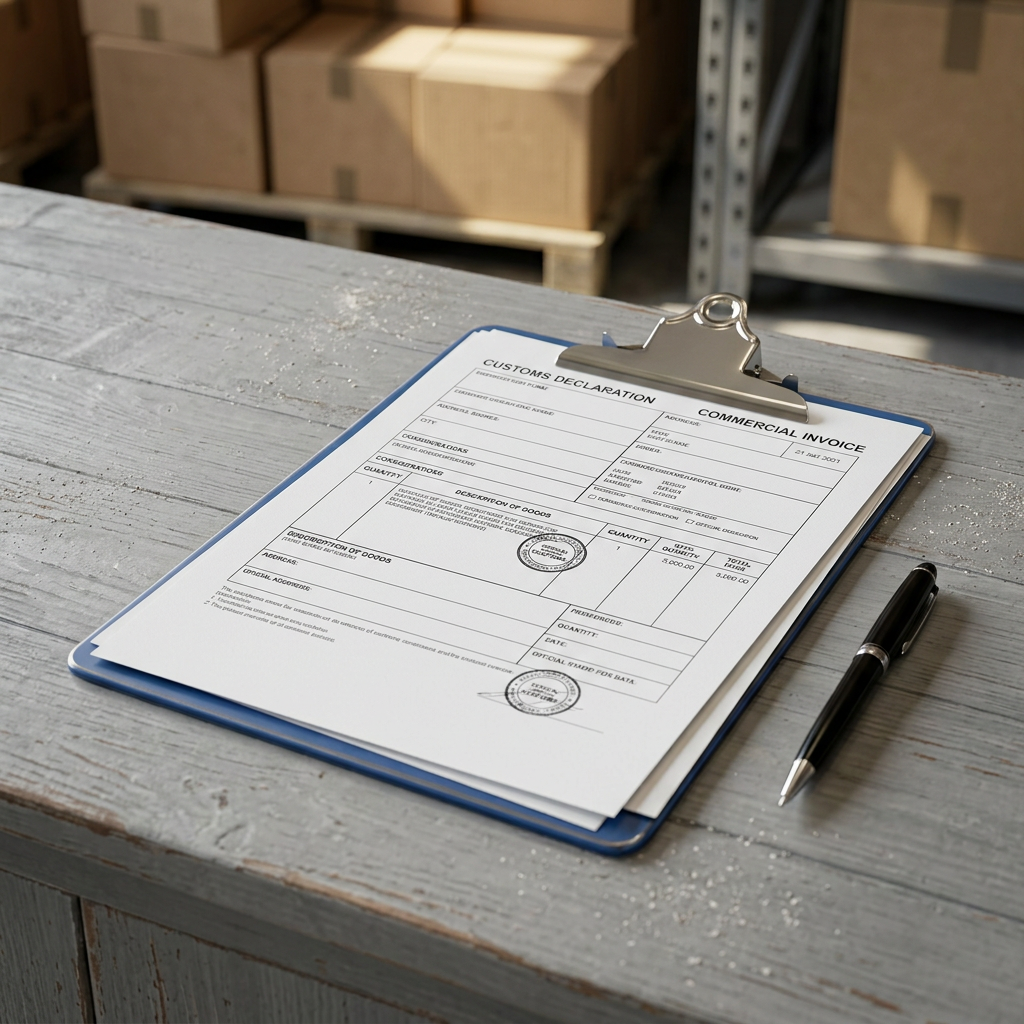
The customs declaration, filed electronically in most cases through the CBSA's Integrated Customs System or CBP's Automated Commercial Environment (ACE), is the formal entry document that triggers the release process. It consolidates information from the commercial invoice, BOL, and any certificates into a single filing. Shippers who rely on manual freight processing to compile this information introduce unnecessary risk, since a single transposed digit in an HS code or a mismatched shipment value can result in a detailed examination that adds days to transit time.
Supporting Documents and Compliance Certificates
Beyond the core invoice and BOL, several supporting documents may be required depending on the nature of the goods, the trade agreement being claimed, and whether any regulatory agencies have jurisdiction over the product category. Overlooking these supplementary forms is a frequent source of border delays, particularly for shippers in cross-border LTL shipping who assume their broker will handle everything without advance preparation.
Certificates of Origin, Packing Slips, and Shipping Manifests
A Certificate of Origin is required when claiming preferential tariff treatment under trade agreements like CUSMA (formerly NAFTA). This document certifies that the goods meet the rules-of-origin criteria and qualifies them for reduced or zero-duty rates. Without it, the importing country will assess the full Most Favoured Nation (MFN) duty rate, which can be substantially higher. According to the CBSA import guide, the Certificate of Origin must be on file at the time of accounting, not after the fact.
Packing slips serve a different but equally important function. While the commercial invoice states values and terms, the packing slip provides the physical inventory: how many boxes or pallets, what each contains, individual weights, and dimensions. When customs officers compare import packing slips against the BOL and invoice, consistency across all three documents signals a low-risk shipment. Discrepancies, even minor ones, raise flags. Similarly, import shipping manifests provide a consolidated summary of all goods on a given vehicle, which carriers must present to border officials before the truck is cleared. For Canadian SMBs shipping cross-border, keeping these documents aligned from the warehouse floor to the border crossing is a matter of discipline and process.
Regulatory Permits and Specialized Documentation
Certain product categories require permits or certificates from specific federal agencies before they can legally cross the border. Food products, for example, may need a Canadian Food Inspection Agency (CFIA) import licence or a U.S. Food and Drug Administration (FDA) prior notice filing. Goods classified as controlled or dangerous goods under Transport Canada regulations require a Transport of Dangerous Goods (TDG) shipping document with precise classifications, UN numbers, and emergency contact information.
Textile and apparel shipments may require a textile declaration, while goods subject to anti-dumping or countervailing duties need additional supporting evidence of origin and valuation. The key takeaway for shippers is that these requirements are product-specific, and the time to identify them is during the booking and preparation phase, not when the truck is 30 minutes from the border. A platform like Truxweb helps streamline the carrier coordination side of cross-border shipping, giving logistics managers more time to focus on getting documentation right rather than chasing quotes and tracking shipments manually.
Digital Document Management and Common Mistakes to Avoid
Having the right documents is only half the challenge. How those documents are organized, stored, and transmitted determines whether your shipment clears customs on the first pass or gets pulled for review. The shift from paper-based filing to digital document submission for freight has accelerated significantly, and shippers who have not adopted a structured approach to shipping paperwork management are at a measurable disadvantage.
Building a Digital Document Workflow
A reliable digital workflow starts with standardized templates for every recurring document type. Commercial invoices, BOLs, and packing slips should follow the same format across all shipments, reducing the chance that a field is accidentally left blank. Cloud-based storage ensures that your customs broker, carrier, and internal team can all access the same version of each document in real time. This eliminates the version-control issues that plague email-based processes, where outdated invoices get submitted because someone forwarded the wrong attachment.
File format matters as well. Most customs brokers and electronic filing systems accept PDF as the standard format for import customs documents, though some platforms support CSV or XML for data-heavy filings. Naming conventions should include the shipment reference number, document type, and date, making it possible to locate any file in seconds rather than digging through folders. Shippers handling LTL freight between Canada and the U.S. often manage multiple small shipments per week, making this kind of structure essential rather than optional.
The Most Common Documentation Errors and How to Prevent Them
The errors that cause the most border delays tend to be mundane rather than exotic. Mismatched values between the commercial invoice and the customs declaration top the list. A shipment invoiced at USD $4,200 but declared at CAD $4,200 without currency specification will be flagged. Incorrect or outdated HS codes are another frequent offender, especially when product lines evolve but the classification codes in the shipper's system do not get updated.
Missing signatures on the BOL, incomplete buyer or consignee information, and failing to include a Certificate of Origin when claiming CUSMA preferential rates round out the most common issues. Shippers who have experienced customs documentation errors firsthand know that the cost of a single hold, including storage fees, rescheduled deliveries, and administrative time, can easily exceed the cost of the shipment itself. Building a pre-shipment checklist that a team member verifies before every booking is the simplest and most effective prevention strategy.
For businesses in Quebec and Ontario managing frequent cross-border shipments, Truxweb's digital platform consolidates carrier communication, booking confirmations, and shipment tracking into a single dashboard. That consolidation frees up the operational bandwidth needed to maintain rigorous cross-border logistics documentation standards, which is where the real savings in avoiding Canada-U.S. shipping delays are found.
Conclusion
Getting cross-border freight documentation right is not a one-time effort; it is a repeatable process that pays dividends on every single shipment. By maintaining accurate commercial invoices, bills of lading, certificates of origin, packing slips, and any product-specific permits, shippers dramatically reduce the risk of customs holds and the costs that come with them. A structured digital workflow, combined with a pre-shipment verification checklist, transforms documentation from a pain point into a competitive advantage for Canadian businesses shipping into the U.S. market.
Ready to simplify the carrier side of your cross-border shipments? Get instant LTL quotes on Truxweb and spend your time on documentation, not chasing carriers.
Frequently Asked Questions (FAQs)
What documents are needed for Canada-U.S. freight shipments?
At minimum, you need a commercial invoice, bill of lading, customs declaration, and packing slip, plus a Certificate of Origin if claiming preferential tariff treatment under CUSMA.
How do Canadian shippers avoid customs delays with proper documentation?
By verifying that all document values, descriptions, and HS codes are consistent across the commercial invoice, BOL, and customs declaration before the shipment leaves the origin facility.
What file formats are supported for document import?
Most customs brokers and electronic filing systems accept PDF as the standard format, with some platforms also supporting CSV and XML for structured data submissions.
What is the document import process for cross-border freight?
The process involves preparing all required documents, uploading them to your broker or electronic filing system, verifying consistency across forms, and submitting them to CBSA or CBP before the shipment arrives at the border.
Which import documents are required for shipping from Ontario to the U.S.?
Ontario-based shippers need a commercial invoice, bill of lading, Canada Customs Invoice (for goods over CAD $2,500), packing slip, and any product-specific permits such as CFIA or FDA filings depending on the commodity.