


Introduction
Every cross-border freight shipment between Canada and the United States depends on paperwork long before a truck reaches the border. For small and medium-sized businesses in Ontario and Quebec, a single missing or inaccurate document can trigger inspections, holds, or penalty charges that turn a routine LTL delivery into an expensive headache. The freight documentation requirements for Canada-U.S. shipping involve at least six distinct forms, each serving a different regulatory purpose for customs authorities on both sides. Understanding exactly which documents you need, and how to prepare them correctly, is the fastest way to keep your shipments moving and your costs predictable.
Core Freight Documents for Every Canada-U.S. Shipment
Whether you are shipping a single pallet from Montreal or a multi-pallet load from Toronto, the same foundational shipping documents apply. Customs officers on both sides of the border expect a consistent set of paperwork that proves the identity, value, and origin of your goods. Missing any one of these can stall your shipment at the port of entry and create cascading delays for every delivery behind yours.
The Commercial Invoice and Bill of Lading
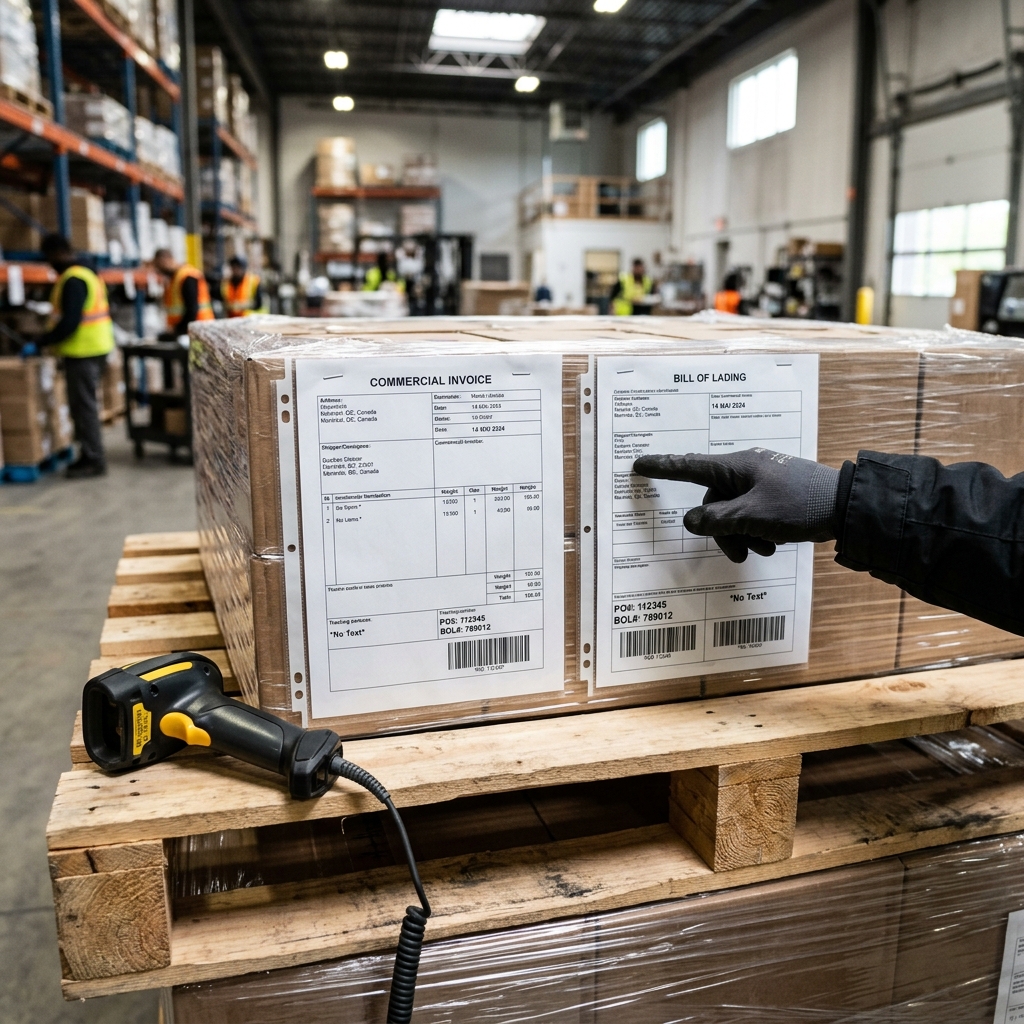
The commercial invoice is the cornerstone of every cross-border freight shipment. It tells customs authorities exactly what is being shipped, its declared value, the buyer and seller details, the currency of sale, and the Harmonized System (HS) tariff codes for each product. Errors in HS code classification are one of the most common customs documentation errors in Canada-U.S. freight, so double-checking these codes before shipping is critical.
The bill of lading (BOL) serves as both a receipt of goods and a contract between the shipper and the carrier. It includes the shipper and consignee addresses, a description of the goods, the freight class, weight, number of handling units, and any special instructions. For LTL shipments, accuracy in the freight class field is especially important because misclassification triggers reclassification fees that carriers will pass along after delivery. A reliable bill of lading template should standardize these fields so nothing is left blank or estimated.
Commercial Invoice: Declares the value, description, HS codes, buyer, and seller for every item in the shipment
Bill of Lading: Acts as a legal contract between the shipper and carrier covering freight class, weight, and handling instructions
Packing List: Provides a detailed breakdown of the contents, quantity, and packaging of each carton or pallet
Carrier Pro Number: The unique tracking identifier assigned by the carrier, linking your shipment to the BOL throughout transit
Shipper Export Declaration: Required by the Canadian government for goods exceeding specific value thresholds destined for export
The Packing List and Its Role at Customs
The packing list is often treated as an afterthought, but customs clearance mistakes that slow down shipments frequently trace back to discrepancies between the packing list and the commercial invoice. A packing list details the exact contents of each package or pallet, including quantities, dimensions, and net and gross weights. When a customs officer compares your packing list to your commercial invoice and finds mismatches in quantities or descriptions, the shipment gets flagged for further inspection.
For businesses shipping LTL freight from Ontario or Quebec, maintaining a standardized packing list format that mirrors your invoice line items eliminates this risk. Each pallet should have its own clearly referenced packing list attached, and every item on that list should map directly to a corresponding line on the commercial invoice. This level of consistency signals to border agents that your shipment is well-documented and low-risk.
Trade Compliance Documents and Common Pitfalls
Beyond the core shipping documents, Canada-U.S. freight requires specific trade compliance paperwork that determines how your goods are classified, what duties apply, and whether your shipment qualifies for preferential tariff treatment. These documents carry legal weight, and errors here can result in fines, denied entry, or forced returns. Getting them right before the truck leaves your dock is non-negotiable.
CUSMA Certificate of Origin and Export Declarations
The Canada-United States-Mexico Agreement (CUSMA) replaced NAFTA as the governing trade agreement for North American commerce. If your goods qualify for duty-free or reduced-duty treatment under CUSMA, you need a CUSMA Certificate of Origin to claim those benefits. Without this certificate, U.S. Customs and Border Protection (CBP) will apply the standard Most Favoured Nation (MFN) tariff rate, which can significantly increase the landed cost of your goods.
The certificate does not need to follow a specific form, but it must contain nine mandatory data elements as specified in the agreement, including the origin criterion, HS tariff classification, and a description of each good. Many SMBs in Quebec and Ontario overlook the requirement to keep these certificates on file for at least five years, which exposes them to compliance audits. For shipments above certain value thresholds, a Shipper's Export Declaration may also be required by the Canadian Border Services Agency (CBSA) to track the movement of goods leaving the country.
The delays that affect cross-border LTL shipping often start well before the truck reaches the border. Preparing your CUSMA certificate and export declaration alongside your invoice and BOL, rather than scrambling to produce them when the carrier calls, prevents last-minute errors that cascade into border holds.
Avoiding Documentation Mistakes That Trigger Border Delays
The most expensive customs freight documents errors are almost always preventable. Mismatched values between the commercial invoice and the customs declaration, incorrect or outdated HS codes, missing consignee details, and unsigned CUSMA certificates top the list. A shipment held at the border for even 24 hours can cost hundreds of dollars in detention fees, storage charges, and missed delivery windows.
One practical approach is to build a pre-shipment checklist that your warehouse or logistics team runs through before every pickup. This checklist should verify that the commercial invoice value matches the packing list quantities, that HS codes have been validated against the U.S. import requirements, and that the CUSMA certificate references the correct goods. Businesses that handle cross-border freight regularly often discover that a five-minute review before dispatch saves days of follow-up after a border rejection.
Organizing Your LTL Shipping Documents Checklist
Having the right documents is only half the challenge. Organizing them so that carriers, customs brokers, and border agents can access them quickly and without confusion is what separates smooth shipments from problematic ones. For businesses shipping LTL freight from Ontario or Quebec into the U.S., the organizational layer matters as much as the documents themselves.
Building a Repeatable Documentation Workflow
Start by creating a standardized digital folder structure for each shipment. Each folder should contain the commercial invoice, BOL, packing list, CUSMA certificate (if applicable), and any carrier-specific forms. Name files consistently using the shipment date, destination, and BOL number so that anyone on your team can locate a document in seconds. This is especially important for LTL shipments where multiple consignments may share a single trailer, and customs brokers need to match your specific documents to your specific freight.
Platforms designed for LTL freight between Canada and the U.S. can centralize this workflow by keeping all shipment-related communication and documents in one place. Truxweb, for example, provides an in-platform dashboard where shippers can manage bookings, communicate with carrier dispatch teams, and track shipment status without juggling separate email threads, phone calls, and spreadsheets. When your documentation lives alongside your booking confirmation and carrier details, the risk of sending outdated or mismatched paperwork drops significantly.
What to Verify Before the Carrier Arrives
The window between booking a shipment and the carrier arriving for pickup is your last opportunity to catch errors. Before the truck shows up, confirm that your BOL reflects the correct freight class, weight, and number of handling units. Verify that your commercial invoice includes accurate HS codes and that the declared value matches your sales agreement. Check that the consignee address on every document is identical, down to the suite number and ZIP code.
For shipments requiring a CUSMA certificate, confirm that the origin criterion listed matches the actual manufacturing or processing that occurred. A common mistake among Canadian SMBs is claiming CUSMA eligibility for goods that contain components sourced outside North America without performing the required tariff shift analysis. Taking the time to validate this before dispatch avoids painful corrections at the border. Cross-border transportation planning for reliable deliveries begins with this kind of disciplined pre-shipment review.
Truxweb's LTL shipping tools for Canada-U.S. routes help shippers compare carriers and lock in bookings quickly, but the documentation responsibility still sits with the shipper. Investing 10 to 15 minutes per shipment in a structured document review is the most cost-effective step any business can take to avoid border complications.
Conclusion
Conclusion
Cross-border freight between Canada and the United States runs on documentation. From the commercial invoice and bill of lading to the CUSMA certificate and packing list, each document serves a distinct regulatory purpose that customs authorities enforce consistently. Building a repeatable checklist, standardizing your file structure, and reviewing every form before the carrier arrives are the habits that separate businesses with smooth border crossings from those dealing with costly delays. The paperwork may not be the most exciting part of shipping, but getting it right every time is what keeps freight moving and margins intact.
Get started with Truxweb to streamline your cross-border LTL shipping and keep all your freight documents organized in one place.
Frequently Asked Questions (FAQs)
What documents do I need for LTL shipping across the Canada-U.S. border?
You typically need a commercial invoice, bill of lading, packing list, CUSMA certificate of origin (if claiming preferential tariff treatment), and potentially a Shipper's Export Declaration depending on the value of your goods.
What documents are required for cross-border freight from Ontario to the US?
Ontario shippers sending freight to the U.S. need the same core set of customs documents as any Canadian exporter, including a commercial invoice, BOL, packing list, and CUSMA certificate if the goods qualify for duty relief.
How do you create a bill of lading for LTL freight?
A bill of lading is created by filling in the shipper and consignee details, goods description, freight class, weight, number of handling units, and any special handling instructions, either through a carrier-provided template or your freight booking platform.
What customs documents does Quebec freight need for US delivery?
Quebec-origin freight bound for the U.S. requires a commercial invoice with HS codes, a bill of lading, a packing list, and a CUSMA certificate of origin if the goods meet the agreement's rules of origin criteria.
How does freight documentation software compare to manual paperwork?
Freight documentation software reduces errors by auto-populating recurring shipment details, centralizing documents alongside booking confirmations, and flagging inconsistencies before the shipment leaves the dock, while manual paperwork relies on individual accuracy and is far more prone to mismatches and omissions.