


Introduction
Shippers, carriers, and dispatchers evaluating a move from manual processes to an automated system need clarity on what works in operations, billing, and service delivery. At the core of that move is a digital freight platform that supports digital freight matching and can act as a digital freight brokerage or digital freight forwarding engine. This article outlines practical benefits, step-by-step implementation guidance, and selection criteria you can test on the dock floor or in the back office.
Top 5 benefits of digital freight matching
Organizations evaluate a freight matching platform because it delivers measurable gains across utilization, speed, and cost. Below are the top five benefits that translate directly into daily operational improvements.
- Faster load-to-truck matches, reducing idle time at terminals and cutoffs for drivers.
- Lower freight costs through increased spot market competition and better lane coverage.
- Reduced empty miles, improving driver utilization and lowering fuel expense.
- Improved visibility and faster exception handling, reducing claims and late deliveries.
- Scalable capacity sourcing, enabling rapid response to peaks and seasonal demand.
Each benefit is actionable: measure match time in minutes, empty-mile percentage per lane, and cost per shipment before and after rollout, then iterate the platform rules.
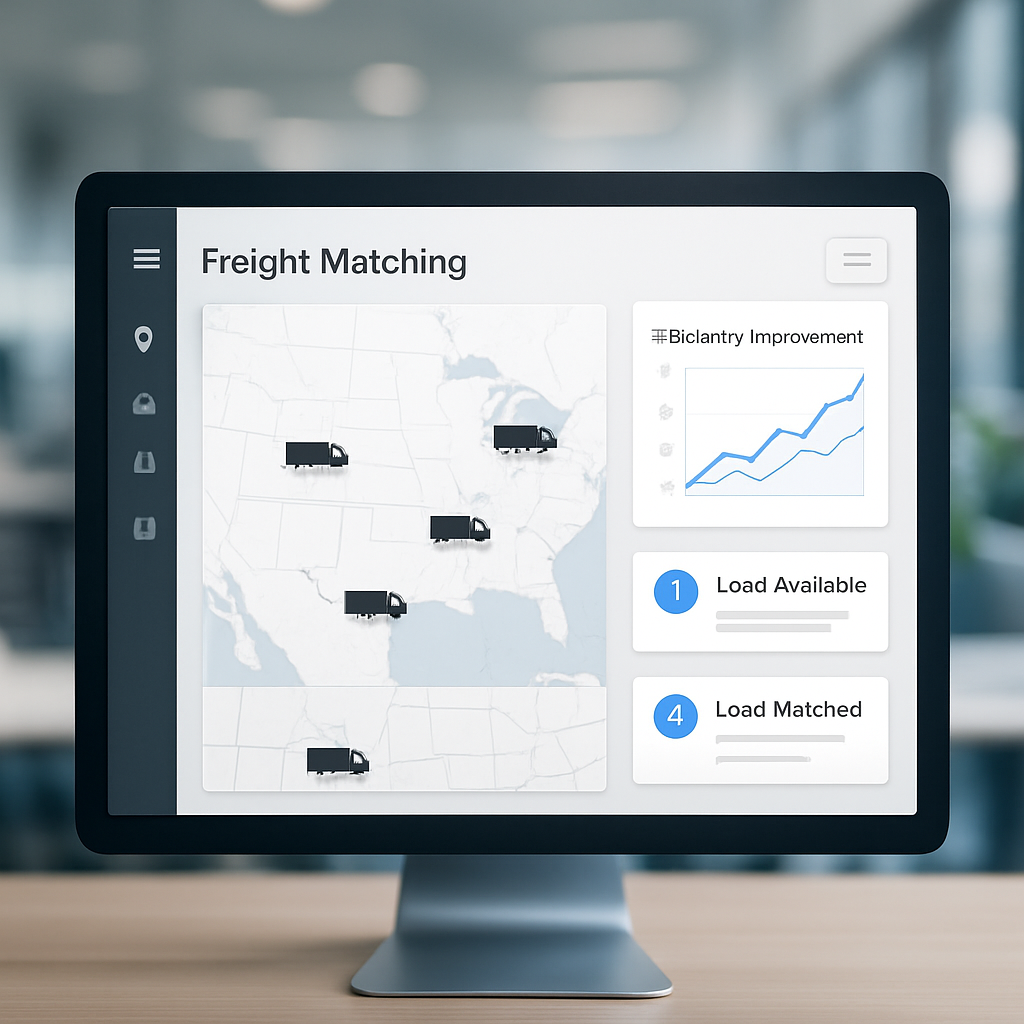
The basic workflow for any digital freight matching or real-time freight matching system follows three operational stages: data intake, match logic, and execution. Data intake ingests load details from shippers or a TMS, and fleet availability from carriers or telematics. Match logic applies rules, pricing, and optimization, using filters such as equipment type, ETA windows, and deadhead limits. Execution triggers booking, documentation, and real-time updates for carriers and shippers. This workflow is the backbone of any online freight booking platform or mobile freight matching app, and it scales from single-lane use to nationwide marketplaces.
Why use digital brokerage or forwarding capabilities?
Using a digital freight brokerage or forwarding capabilities within your platform can shorten cash-to-cash cycles and centralize compliance and documentation. Digital brokers automate proof of delivery capture, rate confirmation, and invoice reconciliation. Digital forwarders add multi-leg coordination, customs events, and international visibility, useful for cross-border shippers operating on a global digital freight platform.
Operational teams benefit in three ways: standardization of quotes and workflows, centralized dispute resolution, and faster onboarding of carrier partners through self-service credentialing and automated checks.

Can digital freight platforms reduce costs and empty miles?
Yes, a properly configured digital freight platform reduces direct costs by improving load acceptance rates and minimizing deadhead. Quantify savings by tracking three KPIs: empty miles percentage, cost per loaded mile, and tender acceptance time. Automation enables dynamic reallocation of backhaul opportunities and consolidated bookings, which can reduce empty miles and improve network efficiency.
Two practical levers that drive savings are dynamic lane pricing to increase carrier match probability and integrating route optimization to group partial loads into full truckloads. Use route optimization freight modules and freight visibility software to capture the benefits end to end.
Operational benefits explained with examples
Below are operational scenarios that show how benefits appear in daily workflows, and what to measure when pilot testing a platform.
- Spot load pickup time falls from hours to minutes, increasing throughput on peak days.
- Carrier onboarding time drops from days to under 24 hours with automated credential checks.
- Dispatcher workload reduces through automatic match suggestions and pre-filled documents.
- Driver ETA accuracy improves when telematics data feeds into the real-time shipment tracking freight view.
- Cross-dock and consolidation planning becomes systematic when the platform suggests optimal carrier mixes and schedules.
Each scenario should be A/B tested during rollout: run the same lanes with manual processes and with the platform to collect comparative metrics on time, cost, and service quality.
How to choose a freight matching platform?
Choosing the right system requires a practical checklist that aligns with your operations, carrier network, and tech stack. Prioritize features that reduce manual touchpoints and integrate with existing systems.
- Integration capability with your TMS, EDI, and telematics providers, to avoid duplicate data entry.
- Real-time matching logic, including support for automated or rule-based matching engines.
- Carrier onboarding and credentialing workflow, with document repository and automated checks.
- Visibility and tracking features, including APIs for live ETAs and event notifications.
- Commercial and settlement tools, supporting spot rates, contracts, and automated invoicing.
For each item, require a demo using your top 5 lanes, and ask vendors for a sandbox to run your real data. Prioritize solutions where you can map KPIs and measure impact in the first 60 to 90 days.
Is digital freight forwarding reliable for international shipments?
Digital forwarding is reliable when the platform supports multi-leg workflows, documented handoffs, and customs event tracking. Look for platforms that provide a single pane of glass for airway bills, bills of lading, and customs clearance events, and that can assign accountability for each leg. A reliable provider will let you configure rules for documentation checks, exception thresholds, and escalation paths to local forwarders or agents.
Integrating the platform into dispatch and carrier operations
Successful integration is both technical and human. From a technical perspective, ensure your web-based freight platform or digital trucking marketplace exposes APIs for bookings, rate pulls, and status updates. From an operational perspective, align dispatchers and carriers on workflows: when to accept automated matches, when to manually select, and how to handle exceptions.
Adopt these integration steps: map data fields between your TMS and the platform, pilot two-way tracking with a subset of carriers using their telematics, and create a cutover plan for tendering and payment. Platforms like Truxweb can accelerate onboarding by providing carrier self-service portals and prebuilt integrations, but ensure you test carrier adoption rates and system reliability before full rollout.
Scaling, compliance, and when to keep manual brokerage
Scaling a scalable freight platform requires attention to capacity diversification and compliance. As trading volumes grow, spread load volume across direct carriers, contracted carriers, and the spot marketplace to avoid single-source risk. Maintain a compliance program that includes automated checks for insurance, safety scores, and regional permits.
There are times to retain manual brokerage: high-value, complex multimodal moves, or lanes with severe service constraints where human negotiation brings better terms. Use digital platforms for repeatable lanes and spot coverage, and reserve manual brokerage for exceptions, contract renewals, and relationship management.
Implementation roadmap for logistics teams
Implementing a freight matching platform is a staged effort. Begin with a 60 to 90 day pilot on a controlled lane set, then expand by adding carriers and automation rules. Key milestones include data mapping, carrier onboarding, pilot execution, KPI validation, and full roll-out.
When implementing, track these metrics weekly: match time, tender acceptance rate, empty miles, on-time delivery, and cost per shipment. If you have an existing TMS, use its data to baseline performance, and then re-measure after 30, 60, and 90 days to validate platform ROI. Consider platforms that support load matching service features and seamless carrier payments to reduce administrative overhead. Truxweb has helped fleets shorten onboarding cycles and improve real-time visibility through integrated booking and tracking workflows.
Conclusion
Adopting a digital freight platform that includes digital freight matching capabilities is a practical way to reduce cost, increase utilization, and scale capacity. Use pilots to verify claims, select vendors that integrate cleanly with your TMS and telematics, and measure operational KPIs to govern expansion. With the right governance model, digital brokerage and forwarding tools can shift routing and pricing from reactive to more data-driven planning, improving service for shippers and earnings for carriers.
Looking to modernize your freight operations?
Explore how Truxweb supports digital freight matching, carrier comparison, and real-time shipment visibility.
Frequently Asked Questions (FAQs)
What is a digital freight platform?
A digital freight platform is a software system that connects shippers and carriers to source, book, and track freight using automation and data-driven matching.
How does digital freight matching work?
Digital freight matching ingests load and carrier availability data, applies rule-based or AI-driven matching logic, and automates booking and tracking workflows.
What are digital freight matching benefits?
Main benefits include faster matches, lower empty miles, reduced operational costs, improved visibility, and scalable capacity sourcing.
Why use digital freight brokerage?
Digital freight brokerage automates confirmations, documentation, and settlements, reducing manual work and improving cash flow and accuracy.
Can digital freight platforms reduce costs?
Yes, platforms reduce costs by improving utilization, decreasing empty miles, and enabling competitive pricing through larger carrier networks.
How to choose a freight matching platform?
Choose a platform with strong integrations, real-time matching, carrier onboarding tools, visibility features, and commercial settlement capabilities.
Is digital freight forwarding reliable?
Digital freight forwarding is reliable when the platform supports multi-leg coordination, documentation control, and customs event tracking.
What is the best freight load board?
The best load board depends on your lanes, carrier mix, and required integrations; prioritize boards that offer API access and transparent pricing.
How AI improves freight matching?
AI improves matching by forecasting acceptance likelihood, optimizing pricing, and recommending high-probability carrier matches to reduce manual tendering.
Can small carriers use digital brokerage?
Yes, many platforms provide mobile apps and self-service onboarding, enabling small carriers to access markets and simplify paperwork.